With Leadership, Culture & Change at the Core
In a world where AI can replicate pricing analytics in minutes, where do companies truly differentiate? According to special guest Dr. Stephan Liozu, an expert in pricing transformation with both academic and corporate credentials, it’s not in tools or data—it’s in mindset, leadership, and collective confidence.
Welcome to a brutally honest discussion on pricing transformation, where the core lesson is this: Pricing is not about technology. It’s about people.
Why Pricing Still Fails: 12 Years On
Twelve years after Stefan completed his PhD analyzing pricing maturity across thousands of companies, the same structural dysfunctions persist. Most firms are still stuck in cost-plus thinking, lack coherent pricing governance, and fail to organize pricing as a strategic function.
Why? Despite all the tools, frameworks, and tech, pricing remains a fragmented profession without a unified voice, cultural visibility, or executive sponsorship.
Moreover, pricing continues to be sidelined in many organizations—perceived as a technical support function rather than a strategic growth engine. Until this perception changes, transformation efforts will remain fragile and isolated.
The “5 Cs” of Successful Pricing Transformation
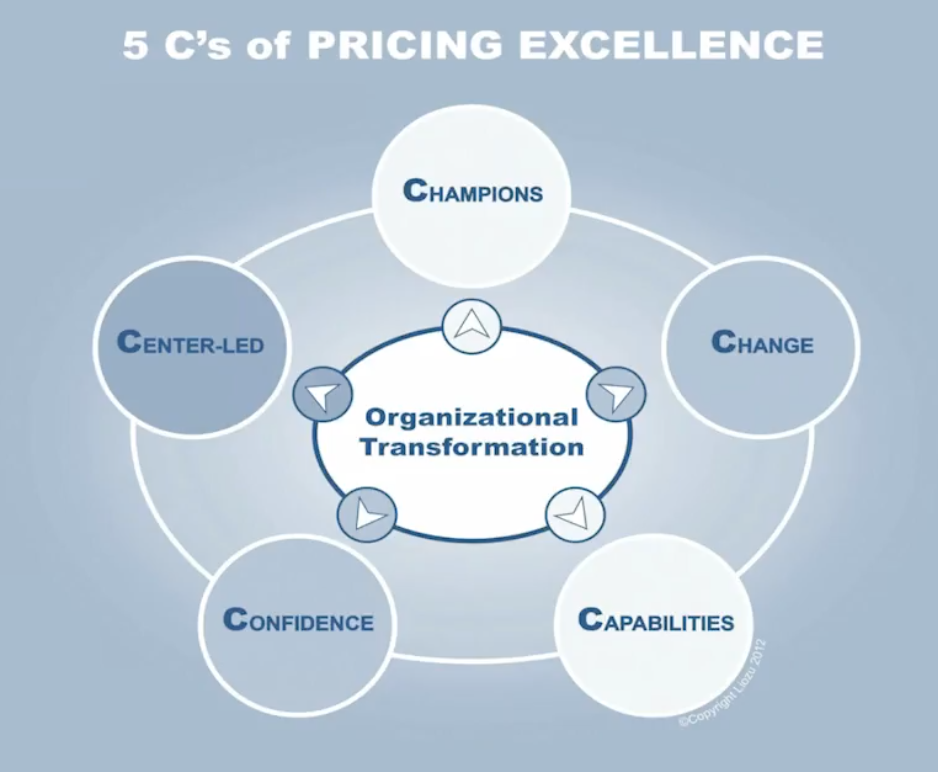
Stefan’s research and field experience point to five critical, non-technical enablers of lasting pricing change:
Champions – C-suite and influential leaders who visibly sponsor and defend pricing.
Change Management – Structured plans to roll out change, aligned with behavior shifts.
Capabilities – Not just technical pricing skills, but commercial acumen and agility.
Confidence – The #1 driver of pricing success. Without collective belief, nothing sticks.
Center-Led – Thoughtful organizational choices around centralization, reporting lines, and role clarity.
These are the pillars that define whether a company escapes the “zone of good intention” and enters the “pricing power zone”—where pricing is a source of competitive advantage, not conflict.
Each “C” is interdependent. Champions without Design may push initiatives that stall. Capabilities without Confidence lead to hesitant execution. Real success lies in harmonizing all five dimensions.
What Can Be Copied—And What Can’t
Yes, your competitors can copy your tools, buy the same software, and mimic your research methods. But they can’t replicate your culture, leadership alignment, or transformation mindset.
As Stefan warns, “You can spend money on tools, but you can’t buy culture.”
That’s where most companies hit the wall. Two similar firms with identical tools can have wildly different outcomes—because one has C-suite alignment and cultural coherence, and the other has infighting and confusion.
This insight underlines the fragility of transformation. It only becomes irreversible when mindset and cultural alignment take root across levels—not just in PowerPoint decks but in everyday decisions.
Mindset, Not Methods: The Core Transformation Battleground
The real battleground is not about tools, but mindsets. Stefan distinguishes three layers of change:
Change Management – Plans, training, stakeholder maps.
Change Leadership – Emotional, visible ownership by leaders who drive urgency.
Mindset Transformation – Deep behavior shifts that become irreversible, surviving leadership changes and reorganizations.
Most pricing transformations fail because they stop at level one.
Successful transformation demands a behavioral reboot. It requires rituals, symbols, and storytelling that embed new beliefs into the culture—transforming pricing from a spreadsheet exercise to a shared commercial philosophy.
Sales: Ally or Saboteur?
Pricing success hinges on sales buy-in. Stefan argues powerfully that pricing must be designed around sales dynamics, not imposed from above. If sales controls pricing in practice, then pricing should report into sales—otherwise it becomes irrelevant.
Key strategies:
Involve sales leaders early so they “own” the change.
Align incentives with pricing goals (profit-based KPIs, transparent bonus schemes).
Make the pricing transformation feel like a joint mission, not a finance audit.
Sales engagement cannot be delegated. It must be owned by pricing leaders who speak the language of the field, respect their commercial instincts, and co-create solutions that make pricing a growth tool, not a governance burden.
Compensation: The Real Barrier (and Enabler)
Stefan is blunt: Compensation design is where most pricing transformations stall. You want to drive margin? Then start by adjusting pay. If sales reps are still rewarded for volume, nothing changes. But most firms avoid the tough conversations—especially with unions, legacy schemes, and opaque bonus rules.
Best practices:
Engage HR from day one.
Use “before/after” simulators to build trust in the new compensation structure.
Phase implementation gradually.
Uncap commissions for high-value sales to incentivize real profit behavior.
And critically, don’t start with Germany or France if you’re facing union constraints. Build credibility and learn in flexible markets first.
Compensation isn’t just a lever—it’s a litmus test. If you can’t align pay with pricing outcomes, your strategy will struggle to scale.
Centralized vs Decentralized: The Pendulum Swings Again
As cost-cutting and de-globalization accelerate, many firms are shifting toward decentralized pricing models. This creates real risks:
Fragmented approaches
Lost best practices
Inconsistent impact
But there’s no one-size-fits-all model. Instead, Stefan advises asking one question:
Where is the power? That’s where pricing should report.
Governance should follow influence, not org charts. Hybrid and center-led models can work—but only if they reflect real decision rights and commercial realities.
Pricing Professionals: Are You Ready for the Future?
AI will soon do most technical pricing tasks. What remains is what can’t be automated: communication, leadership, confidence-building, change orchestration.
Stefan’s challenge is direct: Stop taking Excel courses. Get certified in change management. Read up on emotional intelligence. Become the kind of leader who can move hearts and minds—not just run price waterfalls.
The future pricing leader is not just a quant. They are a translator, influencer, and catalyst. Their value lies in their ability to inspire belief, bridge functions, and lead transformation from the front.
The Bottom Line?
Pricing transformation is fragile, political, and intensely human. But done right, it can be a durable source of competitive advantage. The winners won’t be the companies with the best software—they’ll be those with the strongest confidence, clearest leadership, and most resilient culture.
If you’re leading a pricing journey, remember: You’re not managing prices. You’re managing change.
***
Laurent Dosogne is a partner at Nexo Consulting and host of the Pricing Gym, a peer-to-peer forum for pricing leaders to pressure-test ideas and share candid insights.
Dr. Stephan Liozu is a pricing and value management thought leader. He is an Evangelist for pricing and profit optimization. He speaks, writes, and teaches on value-based pricing, pricing transformations, and pricing strategies. Dr. Liozi has written 8 pricing books and edited another 7. He is dedicated to putting pricing on the executive map and advancing the interests of the pricing profession.
Want to level up your pricing game?
Ready to sharpen your pricing thinking? Join our bi-weekly Pricing Gym sessions where we tackle real-world pricing challenges with no fluff—just practical insights from pricing leaders across industries.